

(De)sacralising
The history of opera, in its deepest essence, has always navigated the threshold of a fascinating paradox: it is at once temple and stage, liturgy and provocation, prayer and cry. From its origins in the Renaissance, lyrical art has drawn on the spirit of ritual and appropriated the solemnity of the sacred, of collective communion and the expectant silence that precedes revelation.
But at the same time, it has been able to overturn this very aura and unveil what dogma conceals, overflowing with bodies, passions and desires what order sought to contain. When the curtain rises, the spectator is not only a witness to fiction, but enters a space where the sacred and the human intertwine like two contrapuntal voices. Arias may sound like prayers invoking an intangible truth; choruses may remind us of the voice of a gathered people, and yet, in the very same instant, stages become chambers of intensity, places where faith, morality and law are put to the test. Opera teaches us that human emotion knows no boundaries, that religious ecstasy and amorous explosion share the same breath.
And it is here that the ritual is completed, for the spectator never attends from the outside. Their presence, their silence, their gaze are part of the liturgy. Faced with what is sung and embodied on stage, they also take a stance —even if only inwardly—, recognising themselves or allowing themselves to be moved, allowing themselves to be questioned. In this shared space, opera is not only performed, but passes through us. And when the curtain falls, something has changed, because the stage ritual also transforms the one who receives it and makes them complicit in this living tension between faith and desire, order and liberation, resistance and revelation.
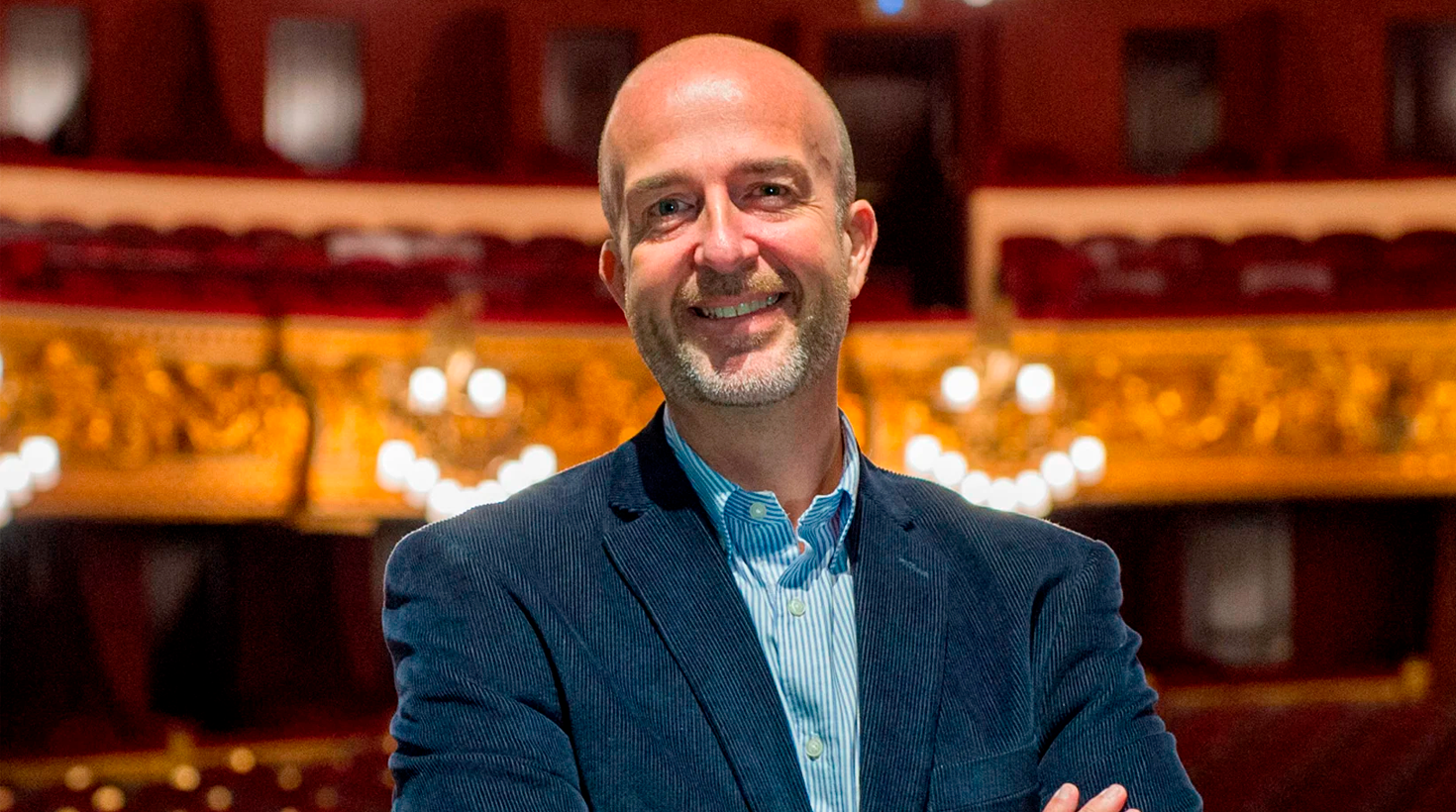
Víctor Garcia de Gomar
Artistic Director of the Gran Teatre del Liceu
With the motto (De)sacralising, the 2026–2027 season of the Liceu stands as a temple of questions, a space where the ancient struggle between the sacred and the sacrilegious runs through every work and every stage gesture. The theatre invites the audience to embark on a journey that questions the deepest roots of our sensibility and our cultural history; an idea that resonates with the tensions of our present.
Each title of the season thus becomes a space in which to reflect on the responsibility of art, its power to reveal fissures and suggest horizons. Thus, Aida emerges as a mirror of major contemporary crises: geopolitical conflicts, the instrumentalisation of power, and the vulnerability of displaced people. Ritual can become a machinery of oppression, and a demonstration of how love, subjected to the empire of hierarchies, claims a space of dignity.
Jenůfa, on the other hand, delves into the invisible violence that a community can generate when it confuses tradition with control. Janáček stages the ethics of the caregiver and the judge, reminding us that social structures can legitimise suffering in the name of a rigid morality.
With The Magic Flute, the sacred takes another form: that of shared knowledge and of ritual as a space of equality. At a time when disinformation erodes coexistence, Mozart revives the idea of initiation as a path towards a lucid and inclusive ethics.
With Das Rheingold, we present the Wagnerian universe as a radical allegory about the origin of domination: desire turned into law, nature desecrated in the name of absolute control. A myth that reminds us that every architecture of power is built upon an initial ethical fracture.
The Exterminating Angel delves into the empty repetition of conventions, social performativity, and the inability to imagine exits from what oppresses us. Adès portrays a community trapped in its own self-referentiality, anticipating the crises of meaning of a society saturated with images but lacking substance.
And La bohème consecrates an aesthetic of care and vulnerability. In a time that calls for new forms of solidarity, Puccini elevates the everyday and turns precariousness into poetry: reminding us that the sacred can be born from a gesture of tenderness.
A set of works, among many others, that form a dramaturgical arc engaging with major themes of our present: the preservation of cultural identity in the face of globalising forces; the revision of power structures that, both in the past and today, can sacralise violence; the search for new forms of community capable of embracing diversity; and the vindication of vulnerability as the core of a more just ethics.
In a world oscillating between the need to believe and the desire to dismantle its own myths, opera emerges as a privileged space to explore this duality with depth, irony, compassion and undeniable poetic force.
The result is an invitation to take part in a season that calls for a sharper and more sensitive gaze, capable of weaving together ethics and aesthetics to turn the theatre not only into a refuge, but also into an impulse to rethink the world we share.

Jonathan Nott
Music Director of the Gran Teatre del Liceu
When I was young, I wanted to sing and I wanted to fly. Everyone can sing —who hasn’t had their parents sing to them or sung to their children?— but, unfortunately, no one can fly! Although that is not entirely true: in music, we can do both. Singing is the expression of the soul, and the primordial power of a human being who sings us a story —a troubadour— was the reason I wanted to become an opera singer. And although my teenage collection of vinyl records of the greatest opera singers (many of them, of course, from the Liceu) grew, my tenor voice did not, and without a voice, there is no operatic career, unless, fortunately, one turns to conducting.
For me, the greatest pleasure of conducting is accompanying, helping, and creating an environment in which other musicians can feel as free as birds, in which they feel supported and inspired.
Music teaches us that time is not as obstinately linear as we human beings fear: that closed circles come much closer to the truth of existence. And now, after many operas, I will join that illustrious list of masters who have been music directors in the very opera house whose singers inspired me at the beginning of my career. I am very excited and feel deeply honoured, more than you can possibly imagine.
The Liceu is a very special and unique place! The belief that music and musical drama belong to everyone, that they are part of the deepest roots of humanity, that pedagogy, social opera, and this innate capacity we all have to sing for one another and with one another are the key to a more open and understanding society, shines like a beacon from the heart of Barcelona. So my question is: how far can we spread the glow of this beacon?
The world is changing. I have been fortunate to create and share music in many parts of the world. I have seen the joy transmitted to the thousands of people attending open-air concerts in São Paulo, and I have observed the change that has taken place in Japanese society over the past decade, as it now feels the need to openly show intense emotions at the end of a “classical” music concert. And I have also witnessed the enormous growth of young audiences shouting “Bravo” in China, in Korea...
The Liceu’s beacon can be a guiding light throughout the world. The Liceu has shown that “classical” music, with the highest standards of performance and singing in the world, is in no way “elitist”, and I would love to share this philosophy with all the inhabitants of this planet!
The Liceu has given me one of the warmest welcomes I have ever received. I am immensely grateful for the kindness shown by Josep Pons and for his love and tireless energy in making the Liceu what it is today. And above all, I am very excited that my first season here, in a house with such a deep Wagnerian tradition, marks the beginning of a new tetralogy together.
Everyone who works for the Liceu, supports it, and is part of its family knows, deep in their being, how special and unique this theatre is. And they know that the more music is allowed into life, the more inseparable life and music become, and the more life turns into music, the more we dance and sing together on this journey. This is the world I would love to live in.
A big hug!