

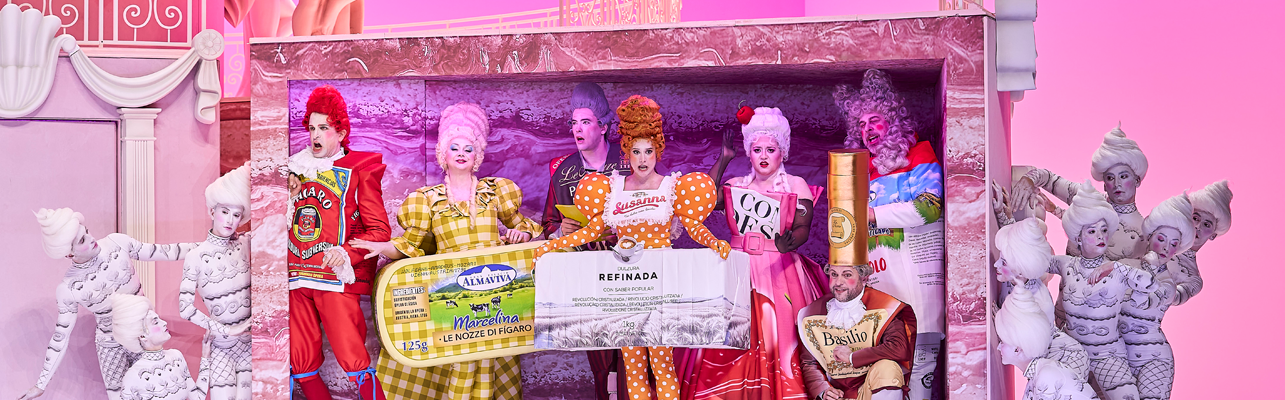
Liceu brings back 'Le nozze di Figaro' by Mozart with a new production by Marta Pazos, musical direction by Giovanni Antonini, and a top-level international cast. An essential opera that combines humour, social criticism and pure emotion.


- Composer
- Wolfgang Amadeus Mozart
- Language
- Italian
- Duration
- 3h 30min
- Subtitles
- Catalan, Spanish and English
- Acts
- 4
- Musical direction
- Giovanni Antonini
- Stage direction
- Marta Pazos
- Cast
- Sara Blanch, Luca Pisaroni, Adriana González, Andrè Schuen, Anna Prohaska, Alejandro Baliñas, Anett Fritsch and Samuel Hasselhorn
Opera is often described as the gymnasium of emotions. In the same way that we go running or swimming to exercise and keep our bodies fit, we also go to the theatre so that the soul does not falter: ultimately, we go to laugh and cry, to feel compassion, affection, anger or pain through characters who connect with the deepest parts of our spirit and remind us how wonderful and terrible it is to live. In this sense, Le nozze di Figaro can be considered one of the most complete and satisfying emotional experiences in the history of art. It has often been described as the opera that best reflects the depth and variety of the human condition —with characters who become flesh and blood, as though they were an extension of ourselves— and, more than 240 years after its premiere, it has lost none of its power to fascinate. That is why we always return to this masterwork of the eighteenth century: because the music is sublime and its message —which can be summed up as never underestimating the power of love, intelligence and forgiveness— continues to offer lessons for our own time.
Is Le nozze di Figaro Mozart’s greatest opera? The debate remains unresolved: Don Giovanni and The Magic Flute also claim that distinction. But one thing is certain: it is Mozart’s finest comic work, and that arguably makes it the pinnacle of opera buffa in history. If we understand Le nozze as a comedy of misunderstandings, then it is a perfect entertainment that offers no respite from surprise and laughter. Yet if it only made us laugh, its impact would be limited: the true power of this opera lies in the way it unleashes laughter only after forcing audiences to look into a moral mirror in which our own greatest flaws are reflected, from envy to indifference toward the suffering of others.
“Le nozze di Figaro is far more than Mozart’s greatest comedy: it is one of the masterpieces of universal art that best reflects the variety and depth of the human spirit.”
An intelligent critique of social inequality
Le nozze di Figaro premiered in 1786 and marked the first collaboration between Mozart and Lorenzo da Ponte, a charismatic and skilful Italian poet with a reputation as a libertine who sought to secure a place at the imperial court in Vienna. The meeting proved beneficial for both men: Mozart had not composed an opera for more than four years because he could not find a suitable story, while Da Ponte had been unable to find a composer worthy of his texts. In the end, they chose to adapt La folle journée, ou le Mariage de Figaro, a controversial comedy by Pierre Augustin Caron de Beaumarchais —the celebrated author of Il barbiere di Siviglia— which had been banned in France for attacking the privileges of the aristocracy. To soften its subversive impact, which would later resonate strongly with the ideas of the French Revolution, Da Ponte agreed before Joseph II, Emperor of Austria, to tone down the social criticism and place greater emphasis on the comic situations.
Nevertheless, the criticism remains, shifted away from pure politics to target the customs and dissolute morality of the ruling class. The opera tells the story of Figaro and his future wife, Susanna, two servants of the Count Almaviva, a Sevillian nobleman with the instincts of a sexual predator. It is their wedding day, and the Count intends to sabotage the marriage by invoking an old feudal right that would allow him to sleep with Susanna before she becomes a married woman. Once the young couple learns of the Count’s intentions, they devise a plan to stop him. Their main ally is the Countess, who suffers from her husband’s infidelities and is painfully aware of them. At the same time, several servants conspire in favour of their master: the housekeeper, Marcellina, claims Figaro as her rightful husband (until it is revealed that he is actually her son), supported by the doctor Bartolo and the music teacher Basilio. The Count’s first attempt to seduce Susanna fails because of the accidental intervention of Cherubino, a young page in love with every woman in the palace, who will later humiliate the Count again when he accuses his wife of having a lover in the second act. In the end, Figaro’s wedding can finally take place, but the Count does not give up his impulses: at the close of the opera, in the resolution of the confusion, he attempts to seduce Susanna in a garden… without realising that she is actually his own wife, who has exchanged clothes with the maid. When he is caught in flagrante delicto, the Count asks for forgiveness and, in a magnanimous gesture, his wife grants it.
“Liceu presents a new production directed by Marta Pazos that, drawing on Susan Sontag’s idea of the ‘camp’, seeks a joyful union between high and low culture.”
A young and experienced cast
Le nozze di Figaro is an opera that is remarkably easy to listen to, a torrent of sweet harmonies and beautiful melodies, yet for singers it is an extremely demanding work. Every vocal line is clear and complex, leaving no room to conceal weaknesses, and each character must reveal their personality with strong acting skills. For this reason, it requires a highly cohesive cast that combines experience and youth, vocal agility and a powerful stage presence. In the upcoming performances at the Liceu —14 in total, including the June 4 performance for the LiceUnder35 community— these demands will be fully supported by a cast that offers every guarantee.
The central role of Figaro, written for baritone, will be performed by veteran specialist Luca Pisaroni and rising Galician talent Alejandro Baliñas. The role of Susanna, for lyric soprano, will be sung by two outstanding performers, Sara Blanch and Anna Prohaska, while the role of the Countess —also for soprano, though with a more dramatic nuance— will be performed by Adriana González and Anett Fritsch. The role of the Count, very similar to Figaro’s, will be sung by two young baritones: Andrè Schuen and Samuel Hasselhorn, while one of the opera’s most beloved characters, the page Cherubino, will also be performed by two sweet-toned sopranos: Russian singer Julia Lezhneva and Argentine soprano Mercedes Gancedo. Doctor Bartolo will be performed by basses Roberto Scandiuzzi and Alejandro López. The remaining characters will each have a single performer throughout the run: mezzo-soprano Mireia Pintó will play Marcellina; Roger Padullés will take on the role of Basilio; Moisés Marín will be Don Curzio; Lucía García will portray the young Barbarina, while the father, the gardener Antonio, will be sung by Luis López Navarro.
“The set design transforms the palace of the story into a wedding cake, which Marta Pazos uses to explore different textures of light and colour throughout the work.”
Sweetness, balance and generous doses of “camp”
When it premiered, Le nozze di Figaro was perceived as a masterpiece that propelled the art of opera forward at breathtaking speed. Mozart, for instance, began to dispense with many recitative passages and sought to convey the action purely through music, laying the foundations for the dramaturgy that would dominate the nineteenth century. At the same time, he had embraced the principles of C. W. Gluck, the great reformer of the classical style, and together with Da Ponte —with whom he collaborated on two further works completing their famous trilogy, Don Giovanni and Così fan tutte— he also pursued a balance between literary and musical quality. Mozart already sensed that the opera of the future would strive for an inseparable union between music and stage action, while at the same time perfectly embodying the conventions of the eighteenth century: unity of action, time and place —everything unfolds on the same day, in the same house, without straying from the central story— and formal symmetry. Everything in this opera, from the number of acts to the status of the characters, functions like a mirror: the characters are arranged in pairs united by the same social condition —the Count and the Countess, Figaro and Susanna, Cherubino and Barbarina, Marcellina and Bartolo— descending from higher to lower rank. This also helps reveal the work’s most powerful underlying idea: nobility of title does not equal nobility of spirit; characters of high birth are capable of wrongdoing, while humble people can embody kindness and intelligence.
The production presented by Marta Pazos, an absolute and exclusive premiere for the Liceu, embraces some of these classical ideas while amplifying them with references drawn from our more recent past. The set design, representing a gigantic wedding cake —the sweetest and most eagerly anticipated moment of any wedding— will remain unchanged throughout the four acts, while the colour schemes and lighting evolve scene by scene as night gradually falls. The vertical structure of the stage allows the characters to be arranged according to their social status, while each costume is defined by a code of flavours, because the characters themselves are the ingredients of a social composition that must be perfectly balanced and, like the cake, taste good. To shape this sweet, daring and colourful proposal, Marta Pazos also draws on the concept of “camp”, theorised in the 1960s by intellectual Susan Sontag, which can be summarised as the idea that there is such a thing as good taste in bad taste: excess and visual overload, or the inclusion of popular culture within elite culture, are valid ways of constructing an intellectual discourse that retains depth while still connecting with a broad audience and expanding its limits. Through this “camp” production, Pazos highlights another of the timeless aspects of Le nozze di Figaro: it is a comic work about ordinary people, and one should never forget that it overflows with humour and everyday life.
The return of Le nozze di Figaro to the Liceu promises to be a complete visual, musical and dramatic experience: a performance worthy of the demands of the score —with maestro Giovanni Antonini conducting the orchestra and a magnificent cast of singers— combined with a bold and entertaining visual concept and a profound intellectual depth that will gradually unfold, spoonful by spoonful, amid a rich density of pastel-coloured textures perfectly suited to the surprising, sugar-coated stage architecture conceived by Marta Pazos.
“The cast is led by Luca Pisaroni and Sara Blanch, representing a wide ensemble of young and experienced voices, with clear singing and strong acting skills.”
Key musical moments
Act I, Figaro
«Non più andrai, farfallone amoroso»
The Count Almaviva has caught the page Cherubino hiding in the room where he was attempting to seduce Susanna, and wants to get rid of him; he therefore sends him off to war. But Figaro will not allow the young man to leave, because he needs him to carry out his revenge. In this first aria by Figaro, the most famous in the opera, Mozart overlays a memorable melody onto the driving rhythm of a military march, creating an even more powerful effect as it forms the grand finale of a first act that unfolds at breakneck speed, linking arias, duets and choral passages, each more irresistible than the last.
Act II, Cherubino
«Voi que sapete che cosa è amor»
In his first aria, included in the first act, Cherubino tells Susanna that he is in love with all the women in the palace, especially the Countess. In the second aria, equally perfect, he tempers his youthful impulsiveness and reveals his insecurities: he is young and, despite feeling uncontrollable passions, still does not know what true love is, so he asks Susanna and the Countess what it feels like to be in love. This is one of the most sublime melodies not only in the opera, but in all of Mozart’s work: a brief moment, fleeting like a summer romance, yet one that lingers in the memory —and in the atmosphere of the story— until the very end.
Act III, Comtessa d'Almaviva
«E Susanna non vien! Dove sono i bei momenti»
While waiting for Susanna to arrive, with whom she has devised a plan to expose her husband at the end of the opera, the Countess Almaviva recalls the time when she was young and happy. In her first aria, at the beginning of the second act, she expressed her sorrow upon learning of the Count’s sexual intentions towards Susanna, but here she experiences a different emotion: through a sweet and compassionate melody, she retreats into an idealised past and lays the foundations for her gesture of forgiveness at the end of the opera. The Countess’s arias are slow and profound, and this final one is among those moments in the opera when it is impossible for the audience not to feel their hearts tighten.