

In 1893, Verdi, at the age of 80, attended the premiere of Falstaff at La Scala. As a major social event, the audience included Princess Letizia Bonaparte and the Italian opera composers Pietro Mascagni and Giacomo Puccini. The composer himself came out onto the stage to greet the audience and was applauded at the end of every act.
With an extensive and extraordinary career spanning almost two-thirds of the nineteenth century, Verdi wished to bid farewell with a great comic work. A devoted admirer of William Shakespeare’s plays, he composed two masterpieces, Macbeth (1847) and Otello (1887), before choosing Falstaff as the basis for his next opera. Only a genius of Giuseppe Verdi’s stature could take leave of opera by proclaiming with sarcasm and wit “Tutto nel mondo è burla” (“Everything in the world is a joke”): the final moral of this bittersweet comedy, in which the composer displayed extraordinary vitality and remarkable modernity.
Verdi revolutionised opera with Falstaff: the work abandons the traditional structure of self-contained numbers in favour of continuous, fluid music; comedy ceases to be purely farcical and becomes more human, ironic and psychological; the orchestra assumes an essential dramatic role, constantly commenting on the action and the characters; the score stands out for its lightness, transparency and refined orchestral colours; Verdi gives great prominence to vocal ensembles and highly sophisticated polyphonic writing; and the opera begins without an overture, plunging directly into the theatrical action.
The Boito–Verdi partnership revives the figure of an ageing hedonist and somewhat cowardly knight, Sir John Falstaff, a former companion-in-arms of the future Henry V of England, now given over to drink, gluttony, lust and boastfulness; faded, short of money, grotesque and vain, yet possessed of a cynical wit and intelligence that make him irresistibly attractive. “Onore!” (“Honour!”) deserves a study of its own: Falstaff utters the word to mock the very concept that means so much to Otello. Two opposing worlds embodied in the composer’s final two operas.
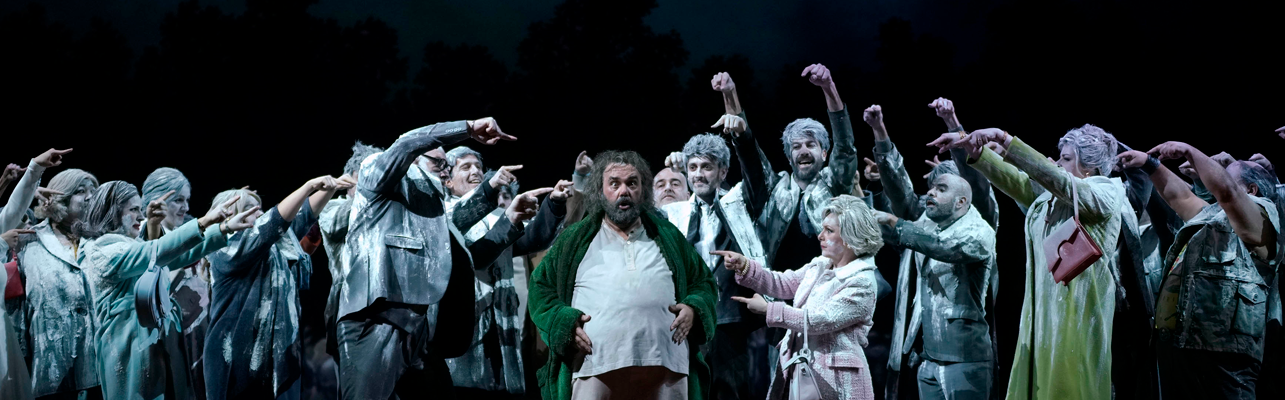
With Falstaff, Giuseppe Verdi’s final opera, Laurent Pelly finds the ideal territory in which to deploy one of his greatest strengths as a man of the theatre: the ability to transform comedy into a lucid reflection on the human condition. Created as a co-production between Teatro Real, the Théâtre Royal de La Monnaie in Brussels, the Opéra National de Bordeaux and the Tokyo Nikikai Opera Foundation, this production places the action in a contemporary, recognisable and familiar world without ever betraying the Shakespearean spirit that inspires Arrigo Boito’s libretto.
Far removed from caricature or exaggerated burlesque, Pelly creates a production that combines realism, fantasy and a subtle observation of social mechanisms. The protagonist inhabits a world of small ambitions, appearances and frustrated desires, an environment that the French director transforms into a mirror of contemporary society. The comedy arises from situations, details and relationships between characters, but also from a profound understanding of their weaknesses.
The set design by Barbara de Limburg plays a decisive role in this interpretation. The spaces evolve throughout the opera and seem to reflect Falstaff’s inner world: from the enclosed and almost suffocating atmosphere of the opening tavern to the gradual opening up of an increasingly imaginary realm. The journey culminates in the nocturnal scene in Windsor Park, where reality dissolves into a poetic and mysterious landscape that allows fantasy to emerge without losing touch with the opera’s earthy humour.
Pelly, who also designed the costumes, creates a gallery of extraordinary characters. The women — Alice Ford, Meg Page, Mistress Quickly and Nannetta — emerge as the true driving force of the drama. Intelligent, supportive and full of energy, they are the ones who orchestrate the theatrical game and expose male pretensions. This ensemble dimension is one of the production’s greatest achievements, making the community itself the protagonist and reinforcing the collective spirit that Verdi envisioned.
Pelly’s Falstaff is not merely a ridiculous old knight or a simple object of ridicule. He is a deeply human, vulnerable and contradictory figure, capable of inspiring both laughter and compassion. His overflowing vitality, his love of earthly pleasures and his determination to defy the passage of time make him surprisingly relatable. In this sense, the production avoids moral judgement and instead celebrates the character’s imperfect humanity.
Laurent Pelly’s Falstaff becomes a vibrant celebration of youth, desire and theatrical playfulness. The entire operatic universe revolves around masquerade, deception and the constant transformation of its characters. The women of Windsor devise a grand theatrical conspiracy to outwit Falstaff with intelligence and irony.
The music moves with breathtaking agility, like a dance filled with vitality and humour. Youth is associated with love, cunning and a life force capable of renewing everything, while Falstaff attempts to resist the passage of time by retreating into seduction and fantasy. The final masquerade transforms reality into an almost magical and carnival-like world. Costumes, practical jokes and assumed identities turn the opera into a grand game. Set in the twentieth century, the production reflects on human fragility and concludes with a mirror in which the audience itself is reflected as the ultimate recipient of the great fugue, inviting us to laugh at ourselves. With extraordinary theatrical agility and unpredictable dramatic gestures, it culminates in a theatrical celebration in which life itself appears as an immense and delightful fiction.
An unforgettable score in the hands of Josep Pons, who bids farewell to the audience of the Liceu as Music Director after 12 wonderful years in the position.
Víctor Garcia de Gomar
Artistic Director of the Gran Teatre del Liceu


