

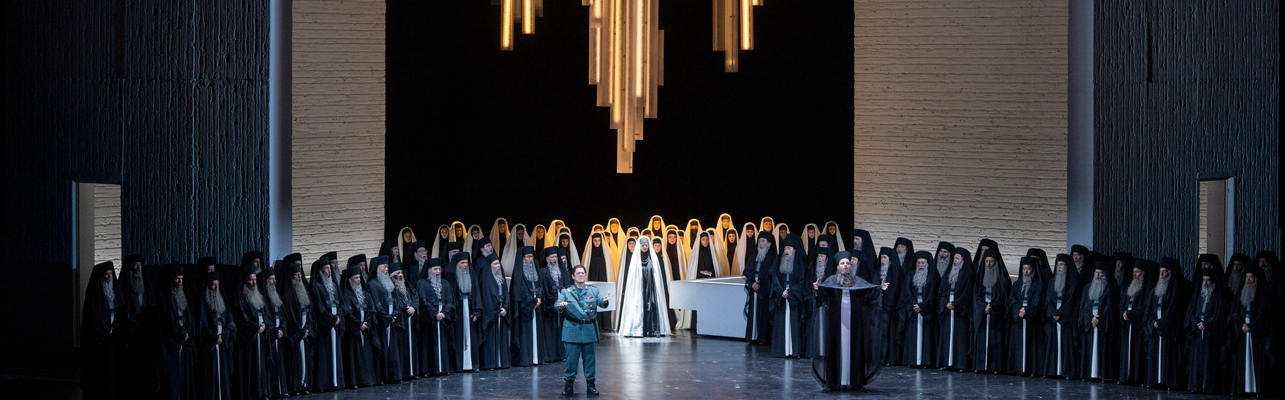
More than 150 years after its premiere, 'Aida' remains one of the great masterpieces of the operatic repertoire. The Liceu opens the 2026–2027 season with a production by Shirin Neshat that offers a fresh perspective on Verdi’s classic, featuring an outstanding cast and an interpretation that highlights human conflict, war, love, and freedom.


- Composer
- Giuseppe Verdi
- Language
- Italian
- Duration
- 4 h
- Subtitles
- Catalan, Spanish and English
- Acts
- 4
- Musical Direction
- Antonello Manacorda / Josep Gil
- Stage Director
- Shirin Neshat
- Cast
- Anna Netrebko, Anna Pirozzi, Yusif Eyvazov, Piotr Beczała, Ekaterina Semenchuk, Ksenia Dudnikova, Artur Ruciński, Igor Golovatenko, Alexander Köpeczi, Simón Orfila
Aida is, in every possible sense, one of the greatest operas of all time. Since its premiere on 24 December 1871, in a setting as unusual yet as fitting for its story as Cairo, Verdi’s masterpiece has remained at the very summit of the operatic canon. It is one of the most beloved titles among audiences—and one of the most feared by the world’s leading singers because of its extraordinary vocal demands. It also contains some of the best-known musical passages, not only in Verdi’s output and the operatic repertoire, but in Western music as a whole. Moreover, it requires a spectacular production: the drama of Aida unfolds amid monumental settings, features a triumphant procession, resounding trumpets and, ultimately, a tragic ending that has always moved audiences. Beyond all this, Aida explores war, hatred, jealousy, longing for one’s homeland and the only force capable of overcoming them all: pure and sincere love that endures beyond death. More than 150 years after its first performance, Aida continues to astonish us with its unstoppable power.
“The Liceu opens its new season with one of Verdi’s and all-time most beloved operas, an intense love tragedy set in ancient Egypt.”
The greatness of this opera can be understood through Verdi’s musical and theatrical evolution. At the beginning of the 1860s, the composer was beginning to leave behind the period he bitterly referred to as his “galley years”—years of hard labour and artistic servitude—when he wrote operas on commission and premiered them relentlessly simply to make a living. However, following the success of La traviata, Rigoletto and, above all, Il trovatore, Verdi finally achieved financial security and artistic standing, allowing him to approach opera without haste or external pressure. His artistic ideal was to achieve a seamless integration of music and drama. He sought compelling stories, excellent librettos and the freedom to compose with care and prepare productions thoroughly before their premieres. He did not fully achieve this until La forza del destino (1862), and over the following ten years Verdi composed only two more operas: his French-style grand opéra, Don Carlos (1867), and Aida, which represents the culmination of this mature, dramatic and monumental period.
A Love Story in the Egypt of the Pharaohs
While Verdi was working at the Paris Opera after receiving the commission for Don Carlos, he met a remarkable figure, Camille du Locle, the theatre’s secretary. Du Locle was fascinated by stories set in exotic places—years later he would play a key role in the creation of Carmen by Georges Bizet—and, during a trip to Egypt, he discovered a collection of stories by the French archaeologist Auguste Mariette in which the slave girl Aida already appeared. Verdi was drawn to the story because it contained everything that interested him: intense passions and an irresolvable love triangle. He eventually decided to create his own version of Aida, especially after the Viceroy of Egypt, a great opera enthusiast, made him an offer he could not refuse—worth the equivalent of one and a half million euros today—to premiere the new work at Cairo’s newly built opera house, coinciding with the inauguration of the greatest engineering achievement of the age: the Suez Canal.
“The production will be directed by multimedia artist Shirin Neshat, who avoids recreating the monumental grandeur traditionally associated with Aida in order to explore its moral conflicts.”
Verdi chose to work with the librettist Antonio Ghislanzoni, who freely reworked Mariette’s story under the composer’s close supervision, transforming it into one of the greatest love tragedies of all time. The action is set in ancient Egypt, at a time of intense political tension, as neighbouring Ethiopia has declared war. The soldier Radamès is appointed to lead the army: he fights out of love for his country, but also because he dreams of winning glory and marrying Aida, a beautiful slave in the service of Amneris, the Pharaoh’s daughter. Amneris is also in love with Radamès, but suspects that his heart belongs to someone else, until she discovers that her rival is Aida, who harbours a secret: she is in fact the daughter of Amonasro, King of Ethiopia, who has invaded Egypt to rescue her. Radamès, however, returns victorious from battle, bringing many prisoners with him. Among them is Amonasro, who conceals his true identity. Only Aida recognises him. The Ethiopian king seeks to exploit Radamès’s love for Aida in order to obtain military secrets that will help them escape, leaving the princess-slave caught in the opera’s central conflict: should she remain loyal to her homeland or to her love for Radamès? Aida escapes with the help of her beloved, who is accused of treason and sentenced to death. Amneris thus achieves her revenge. At the end of the opera, however, Aida returns and joins Radamès in the tomb where he is to be buried alive: there they will remain together for all eternity.
A Thrilling Duel of Divas
Aida is an exceptionally demanding opera for singers. Radamès must perform his first aria almost immediately at the beginning of the work, while the heroine’s most iconic moment comes near the very end, when the soprano has already endured immense vocal demands. The opera also features powerful choral scenes and highly charged duets. As a result, it requires extraordinary talent to be performed at the highest level.
This will certainly not be an issue in the performances that will open the Liceu’s 2026–2027 season. The title role will be performed by four dramatic sopranos, led by the renowned Russian diva Anna Netrebko—who will appear in four performances, including opening night—alongside Anna Pirozzi, Olga Maslova (six performances each) and Ewa Plonka. The role of Radamès will be sung by three world-class spinto tenors: the Polish tenor Piotr Beczała, already a familiar favourite at the Liceu, and the Armenian tenors Yusif Eyvazov and Arsen Soghomonyan.
“Russian soprano Anna Netrebko, the great diva of the 21st century, leads a distinguished and experienced cast featuring tenor Piotr Beczała and soprano Anna Pirozzi.”
The role of Amneris, written for mezzo-soprano and requiring a finely balanced relationship with Aida in their fierce confrontation during the second act, will be performed by three highly experienced artists: Ekaterina Semenchuk, Ksenia Dudnikova and Fiorenza Cedolins. The bass roles of the Pharaoh and Amonasro will be sung respectively by three basses—Riccardo Fassi, George Andguladze and Vittorio De Campo—and three baritones: Artur Ruciński, Igor Golovatenko and Àngel Òdena. The remaining roles will be shared by Moisés Marín (the Messenger), Carmen Buendía and Núria Vilà (the Priestesses), and the basses Alexander Köpeczi, Giorgi Manoshvili and Simón Orfila (Ramfis). The orchestra will be conducted by Antonello Manacorda and Josep Gil.
A Reflection on War and Hatred
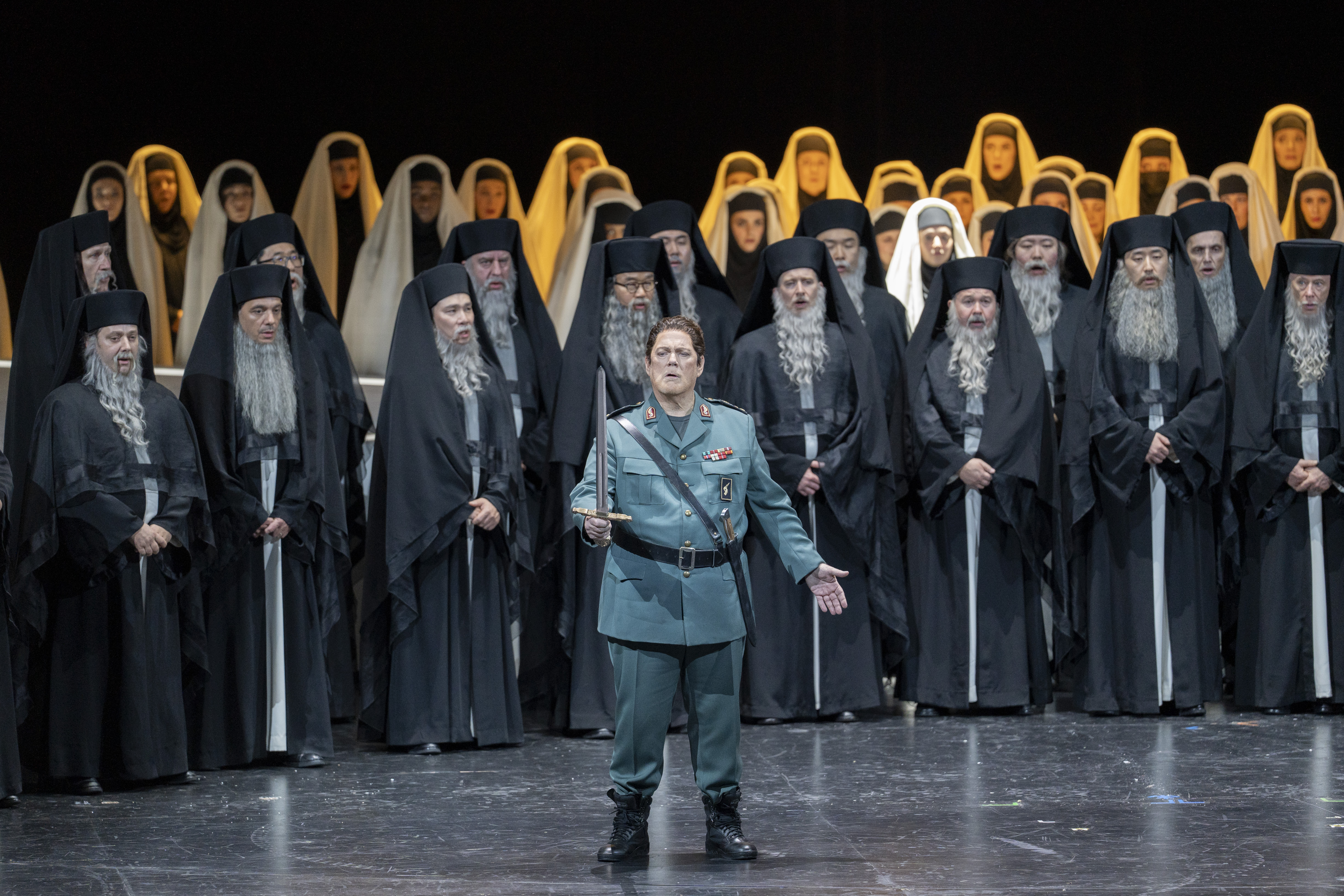
Alongside its outstanding vocal cast, the greatest artistic attraction of the upcoming performances of Aida at the Liceu is its production, which breaks away from many of the stereotypes traditionally associated with the opera: monumental sets, the grand triumphal march, lavish costumes and even the imagery inspired by ancient Egypt. The production is created by one of the most important multimedia artists of recent decades, the Iranian-born Shirin Neshat, who has been based in New York since the 1970s. A photographer, filmmaker—awarded the Silver Lion for Best Director at the 2009 Venice Film Festival for her film Women Without Men (Dones sense homes)—and multimedia artist, Aida marks her first venture into opera stage direction. Originally commissioned by the Salzburg Festival and ultimately realised at the Paris Opera, the production is built around a central idea: the characters’ inner conflicts matter more than the monumental setting of the story. Who is Aida? Is she a slave or a princess? Is she free to choose her own destiny? What is her true relationship with her father? How profound is her love for Radamès?
“Neshat’s vision offers an original female perspective and focuses on the senselessness of a war that divides two peoples and prevents its heroine from being truly free.”
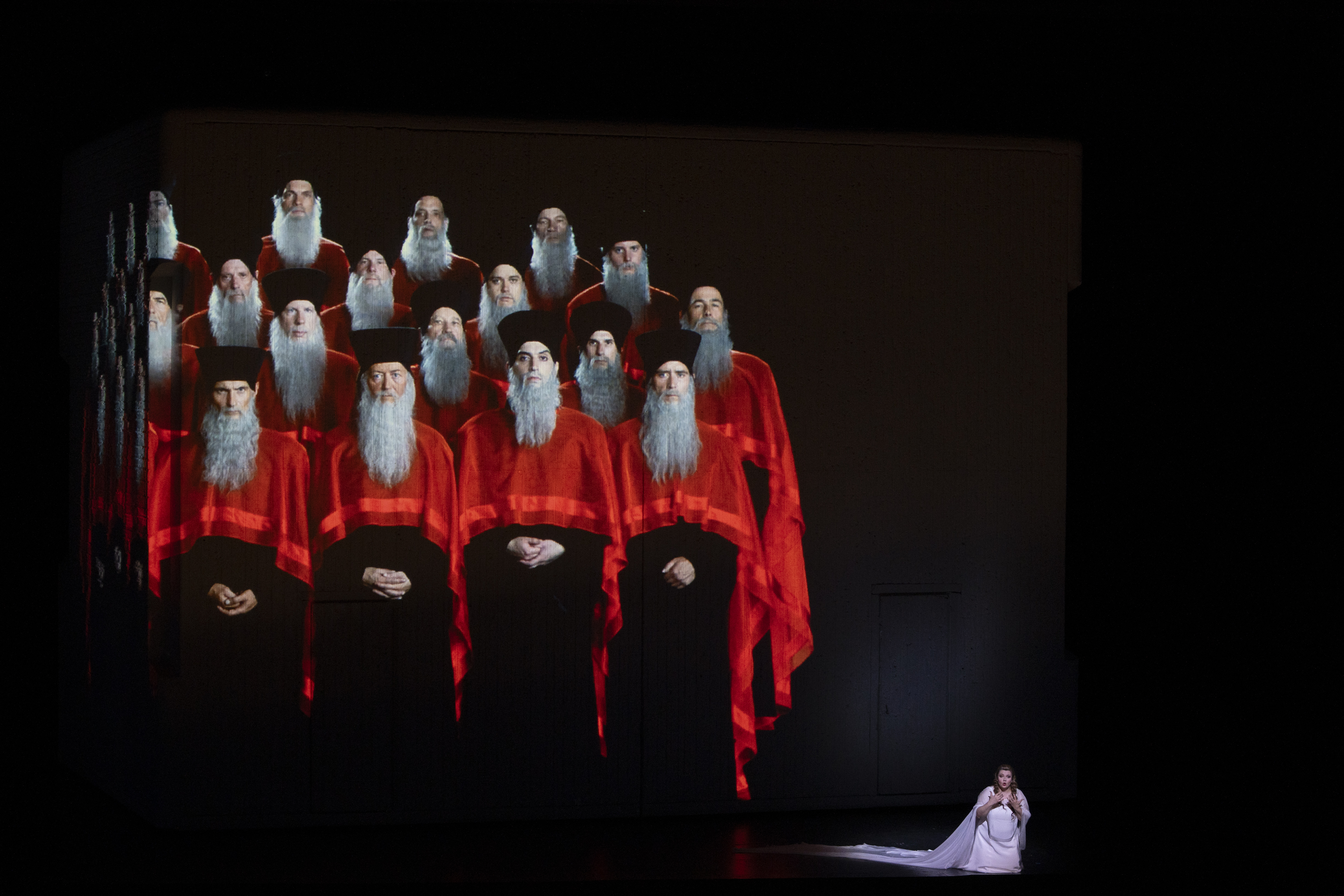
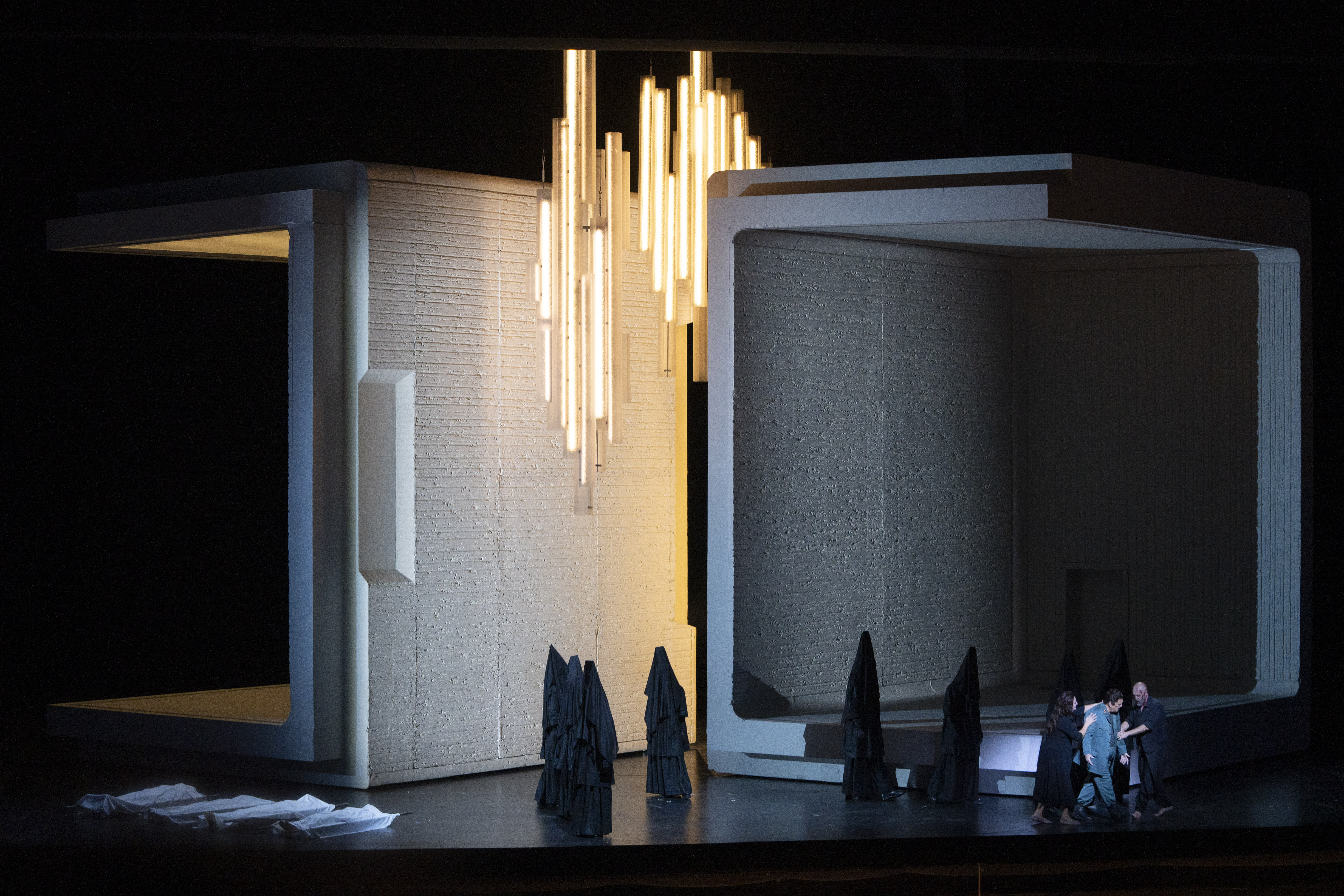
Shirin Neshat has always brought a female perspective to her work, and one of its recurring themes is the role of women in society, particularly in Muslim countries. Her artistic vision consistently engages with the wider conflicts of her own time. In this production of Aida, she also places special emphasis on another central theme: the irrational hatred that the characters feel towards foreigners and those who are different. The war between Egypt and Ethiopia is fundamental to the opera—a conflict devoid of purpose or honour, generating only hatred and making reconciliation and a prosperous future impossible. For this reason, Neshat’s production is immersed in a dark and pessimistic atmosphere and, rather than celebrating the victor’s glory, portrays the imminent collapse of a civilisation. Instead of monumental sets, the staging revolves around a large movable stone structure that transforms into every setting—the temple, the tomb and the palace. Many of the opera’s reflections on the human condition are conveyed through an elegant and imaginative use of video projections and chiaroscuro lighting. Although the political and social reading is unmistakable, Neshat deliberately avoids linking it to any specific historical or contemporary conflict. Instead, her moral reflection is universal, applicable to Europe, the Middle East or anywhere else in the world, and rooted in the idea that hatred and conflict ultimately consume us without offering hope or solutions. Just as they do in the opera itself.
The upcoming performances of Aida at the Liceu therefore offer an experience that speaks equally to the intellect and the senses: an outstanding artistic production that invites audiences to rediscover the opera from a fresh perspective, demonstrating that the enduring vitality of Verdi’s masterpiece lies not only in its sublime arias, but also in the timeless relevance of the conflicts and passions that inspired its extraordinary music.