

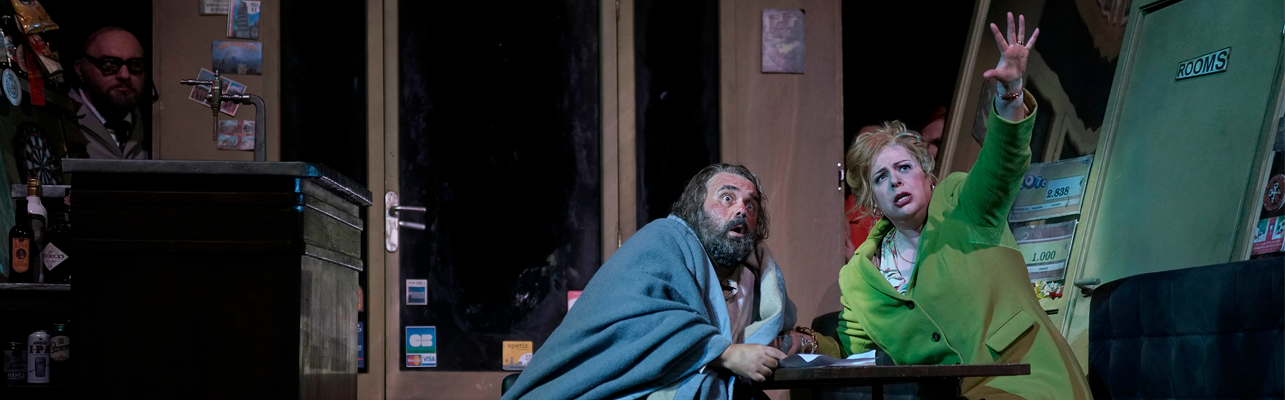
'Falstaff', the final opera by Giuseppe Verdi, arrives at the Liceu as a brilliant comedy inspired by Shakespeare. With innovative music, a plot full of entanglements and humor, and the direction of Josep Pons in his farewell as musical director, this production by Laurent Pelly reclaims the theatrical and musical genius of the Italian composer.


- Composer
- Giuseppe Verdi
- Language
- Italian
- Duration
- 2 h 40 min
- Subtitles
- Catalan, Spanish and English
- Acts
- 3
- Musical direction
- Josep Pons
- Stage direction
- Laurent Pelly
- Cast
- Luca Salsi, Ambrogio Maestri, Lucas Meachem, Igor Golovatenko, Carolina López Moreno, Roberta Mantegna, Daniela Barcellona, Marianna Pizzolato
When Verdi began composing Falstaff, he was almost eighty years old. The extraordinary energy he had possessed in his youth had long since faded, and he needed several years to complete the score and have it ready for the premiere of the work in Milan, in February 1893.
Despite this, that slow and weary Verdi was also a Verdi at the peak of his genius, who mastered the tools of his craft and accumulated an experience that no one in his profession could match. Thus, thanks to his fame and prestige, he was able to make a final effort to complete the musical journey of his life and achieve the artistic ideal he most desired: the total synthesis between music and theatre.
In Verdi’s case, there are several operas that achieve excellence in the union of text, music, and dramatic sweep —La traviata, Don Carlos, Aida and Otello (1887)— but for him there was always room for improvement. The example of his final title proves it, because Verdi even allowed himself to step outside the conventions of his own operas and indulge in ending his career by correcting the biggest stumble of his youth.
His second opera, Un giorno di regno (1840), was a comic piece and was premiered without success or impact. Verdi was close to abandoning his career —the success of the next one, Nabucco (1842), erased this idea from his mind— but during the following decades he carried that thorn in his side, and finally found the opportunity to remove it and place a majestic seal on his unsurpassed career.
Evidently, Shakespeare
In 1871, after the premiere of Aida, Verdi decided to abandon opera composition forever. For more than fifteen years he remained silent, but returned in 1887 with Otello. He did so because the charismatic Arrigo Boito appeared before him with a sublime libretto adapting Shakespeare’s homonymous tragedy, written with immense literary stature. For Verdi, Shakespeare represented the pinnacle of theatre, and although he had only composed one opera based on a drama by him —Macbeth, in 1847—, he never lost hope of returning to his texts. Thanks to Otello, Verdi recovered an enthusiasm for opera that he seemed to have lost, and after the triumph of its premiere, Boito took advantage of the creative momentum he had achieved with Verdi to seduce him with a new project inspired by Shakespeare. In this case, he chose the character of Falstaff, who does not have any play bearing his name in the author’s catalogue, but who appears in three works: the two parts of Henry IV and The Merry Wives of Windsor. Who is Falstaff? At first he is the best friend of Prince Hal, who breaks off the relationship with him when he becomes King Henry IV. Falstaff feels abandoned and devotes himself to a life of cynicism and excess, and at the beginning of the opera, which mainly takes its plot from The Merry Wives of Windsor, we find him in a tavern turned into a careless, fat, and impoverished old man, who nevertheless believes he still possesses charm and seductive power.
“Written by Arrigo Boito based on two works by Shakespeare, the opera presents a series of entanglements that generate outrageous situations and a great game of intelligence.”
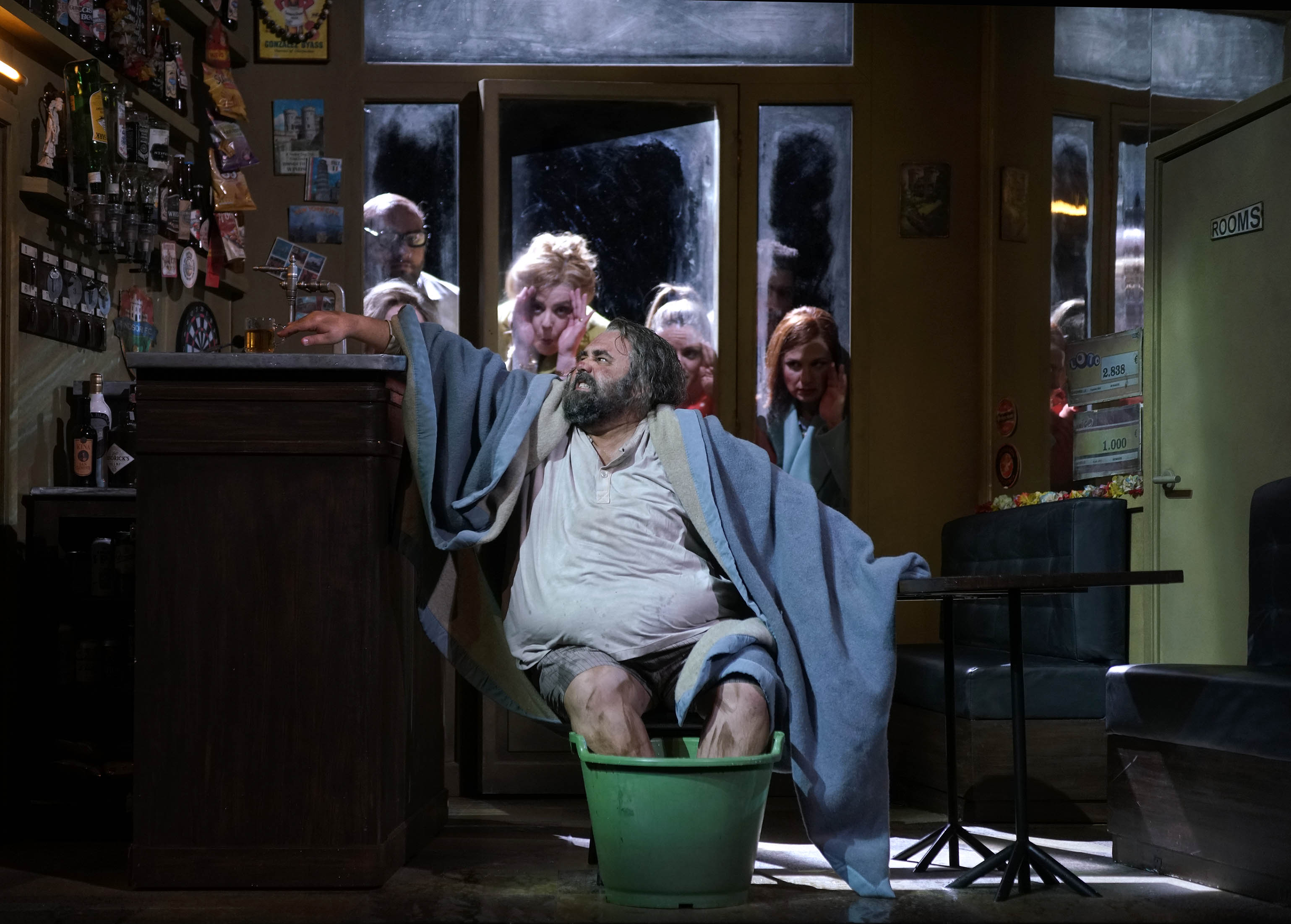
Accused of theft and in need of money, Falstaff comes up with an absurd plan: to seduce two well-off ladies, Mistress Ford and Mistress Meg Page, so that they will pay for his whims. Falstaff’s two servants, Bardolph and Pistol, consider it a shameful proposal that violates their honour, and after being dismissed by their master, they go to Mr. Ford’s house in Windsor to warn him that Falstaff is trying to corrupt his wife. At the same time, Mistress Ford and Mistress Meg Page have received Falstaff’s love letters, and they burst out laughing and decide to devise a plan to humiliate him. This is how the most complicated part of the farce begins: Mistress Page agrees to receive Falstaff in order to mock him, and in parallel, without her knowing, her husband does the same, also to test his wife’s fidelity. In a second act of brilliant comedy, Falstaff goes to the Ford household and ends up hidden in a basket of dirty laundry when the husband arrives unexpectedly and believes his wife is cheating on him. Finally, the buffoon is thrown into the River Thames (inside the laundry basket).
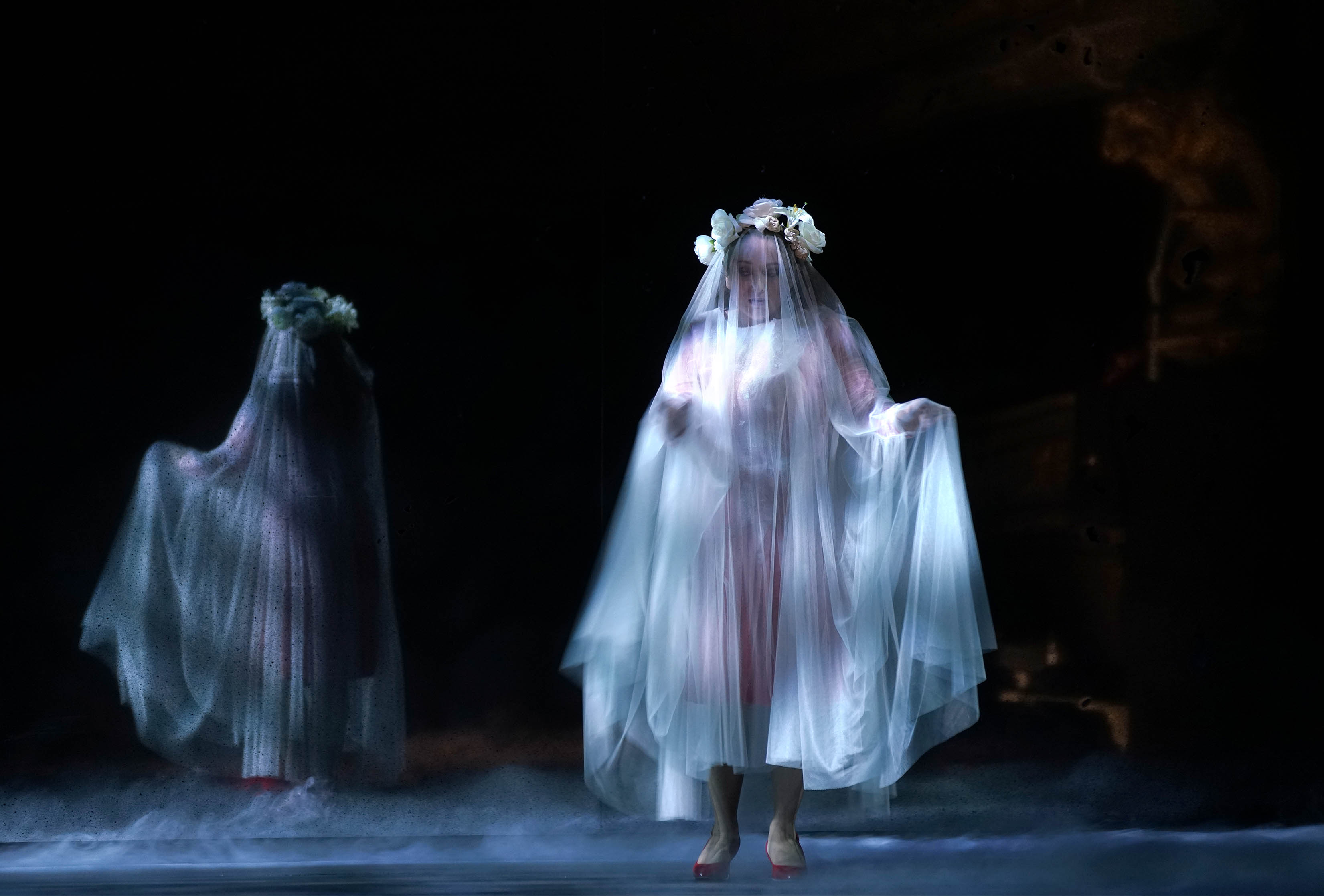
In the third act, and after several further entanglements and humiliations, the mockery reaches its peak: the people of Windsor summon Falstaff at night in a forest, where they disguise themselves as fairies and ghosts to frighten him. A secondary plot is also resolved: the Ford’s daughter, Nannetta, manages to escape her father’s intention to marry her off to an old doctor, Doctor Caius, and amid the confusion succeeds in having a marriage ceremony performed with her secret boyfriend, the young Fenton. In the end, both Falstaff and Mr. Ford receive a severe lesson from a group of intelligent and astute women. This is how Verdi concluded his operatic career with a great laugh, with a delightful comedy.
Josep Pons’s joyful farewell with a magnificent cast
For a performance of Falstaff to succeed, not only are good singers needed, but those singers must also be good actors. This opera is very different within Verdi’s catalogue: there are hardly any famous arias, its language is closer to the 20th century than to Romanticism, and its greatest virtue lies in the absolute integration of music and text. The orchestral writing is complex and grand, every word carries its precise meaning, and all the melodies serve the action, rather than allowing the singers to display themselves. This does not mean that the score is not sublime —as it is full of lyricism and admirable moments—, but what matters is that Falstaff is sung theatre, a sequence of songs in a theatre.
“Maestro Josep Pons, who is bidding farewell to his role as musical director of the Liceu, will lead all performances from the orchestra pit, thus offering a final gift to the theatre’s audience.”
In these performances at the Liceu, the title role —always reserved for bass-baritones with long experience and an imposing physical presence— is performed by two specialists: the Italians Luca Salsi and Ambrogio Maestri. Alongside them are the sopranos Carolina López Moreno and Roberta Mantegna as Mistress Ford, the mezzos Gemma Coma-Alabert and Laura Vila as Mistress Meg Page, and the also mezzos Daniela Barcellona and Marianna Pizzolato as Mistress Quickly. The fourth female role, Nannetta, for lyric soprano, will be sung by Serena Sáenz and Maria Miró. In the male roles we have the baritones Igor Golovatenko and Lucas Meachem as Mr. Ford, and the tenors Santiago Ballerini and César Cortés as Fenton. The tenor Josep Fadó is Doctor Caius, and Falstaff’s servants, Bardolph and Pistol, are Pablo García-López and Alessio Cacciamani, respectively.
In any case, within the artistic team there is a figure who, exceptionally, takes up a large part of the spotlight in these performances. Josep Pons, who has been music director of the Liceu since 2013, bids farewell to the post with an opera made for him: demanding for the orchestra, perfectly balancing the languages of Romanticism and early modernism, and carrying a special symbolic value. Pons’s tenure at the Liceu has been unforgettable, and although he will return from next season as a guest conductor, it was only right to close the cycle with joy and optimism.
The great theatre of the world
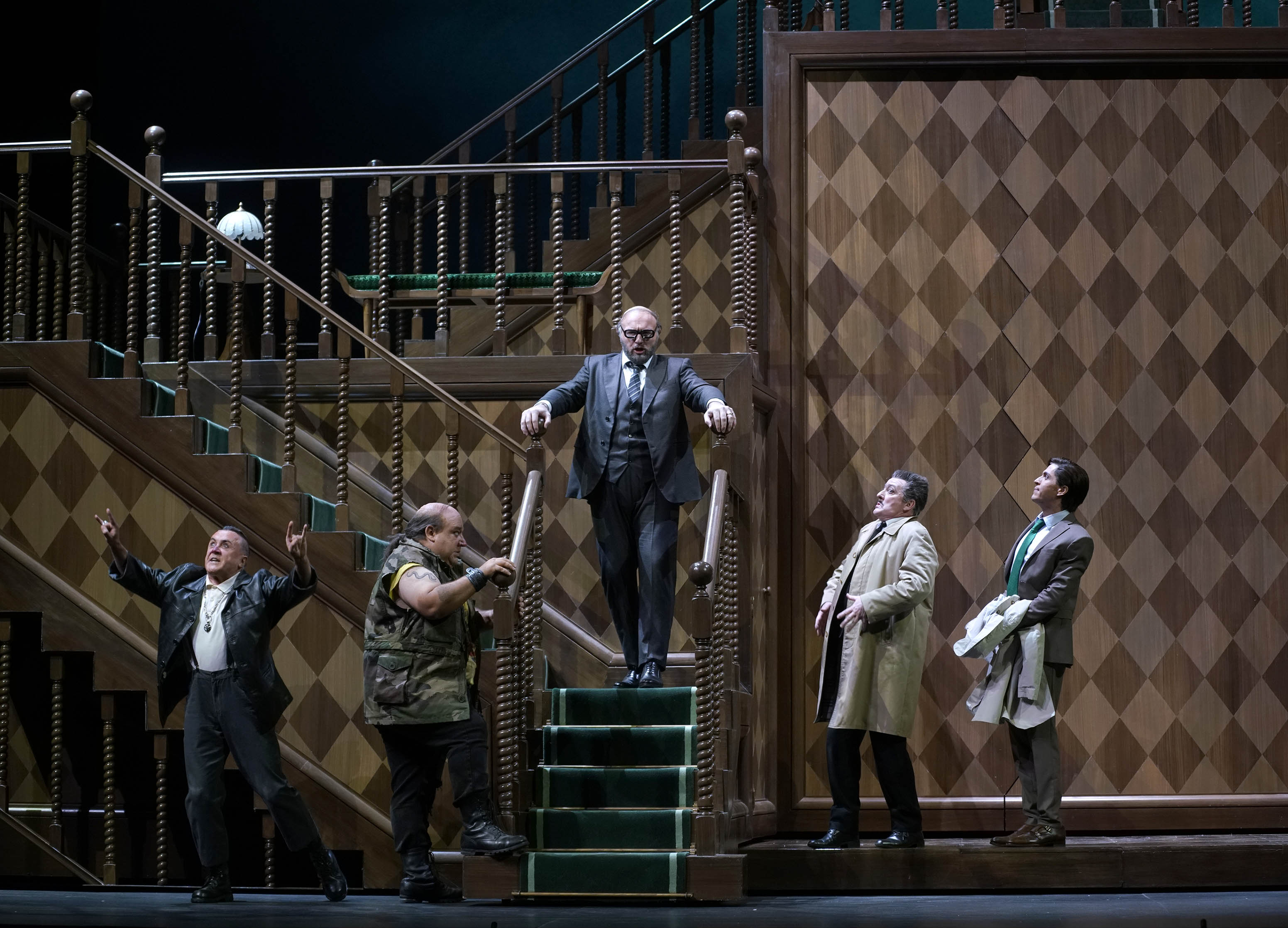
In the upcoming performances we present Laurent Pelly’s production of Falstaff, an original staging from the Teatro Real in Madrid that remains faithful to Verdi’s desire: to be theatre in its highest expression. Pelly is a great specialist in comedy, and in Falstaff he frames the characters in realistic settings that enhance all theatrical situations and bring out every effect the work seeks: the second-hand embarrassment we feel for Falstaff, the admiration inspired by the wit of the wives, the sense of an impossible-to-resolve entanglement, the magical atmosphere of the end of the third act… The tavern where Falstaff lives becomes, in this production, an old-style bar-restaurant, baroque and cluttered with bottles and mirrors, while the Windsor scenes take place in an interior space shaped like a labyrinth or an Escher-like staircase: situations become increasingly complex inside it, until they are finally resolved outdoors, in the forest of the third act. There is where Pelly reaches the most aesthetically beautiful moment and allows himself a brilliant conceptual detail: at the end of the opera, when Falstaff utters his famous final words —“all the world is a joke”— the stage reveals a giant mirror in which the entire auditorium is reflected.
“The cast will be led by the baritones Luca Salsi and Ambrogio Maestri, two specialists in the role of Falstaff, with great comic resources and an admirable voice.”
Shakespeare said that the world was a great stage, and this production, in service of a work of great human depth, embraces that idea: it is not only a perfect fusion of theatre and music, it is music at the service of all emotions and all forms of intelligence, and its dramatization does not remain on stage but extends into the realm of the real world. That was Verdi’s intention, and the enduring prestige of his final opera proves him right. It is not his most famous composition, nor the one with the most memorable musical numbers, but it is arguably his most solid opera as a whole, the one that confirms the immensity of his genius.
Key musical moments
Act I, Falstaff
“L’onore! Ladri!”
Falstaff does not have many arias or major solo moments for the singers: there is Fenton’s passage in the third act, some sections for Nannetta… and this monologue by the protagonist at the end of the first scene, in which he reproaches his servants for having no sense of honour. This fragment is the most evident borrowing Arrigo Boito took from the text of Henry IV, an addition to the plot of The Merry Wives of Windsor that has the virtue of fully presenting Falstaff’s character: cynical, yet noble; boastful, yet without true malice. It also requires the performer to give their utmost not only vocally, but also in the dramatic credibility of their acting.
Act III, Falstaff
“Tutto nel mondo è burla”
After discovering that he has been the victim of a great deception, Falstaff decides to take the humiliation with humour: he understands that he has not been the only one to fall into a trap and that no one escapes the complexity of the world; therefore, the best approach is to face it with good spirit. This final part of the opera not only contains a famous phrase, but is also a compositional display by Verdi, who used the ancient form of the fugue to conclude his most modern opera. The musical result is insistent and, at the same time, allows the rest of the characters, who join the chorus, to take part in the opera’s optimistic message.